Transrectal Ultrasound Cattle: The Modern Standard for Accurate Bovine Reproductive Diagnosis

Transrectal Ultrasound Cattle: The Modern Standard for Accurate Bovine Reproductive Diagnosis
Efficient reproductive management is one of the most important factors influencing the profitability of dairy and beef cattle farms. Accurate diagnosis of pregnancy, ovarian activity, and reproductive disorders enables producers to improve breeding efficiency, shorten calving intervals, and maximize herd performance.
Today, transrectal ultrasound cattle examinations have become the preferred diagnostic method for veterinarians, breeding technicians, and livestock producers worldwide. Compared with traditional palpation, veterinary ultrasound provides real-time visualization of the reproductive tract, allowing earlier and more precise clinical decisions.
As portable veterinary ultrasound technology continues to evolve, cattle reproductive examinations have become faster, more accurate, and more convenient than ever before.
What Is Transrectal Ultrasound in Cattle?
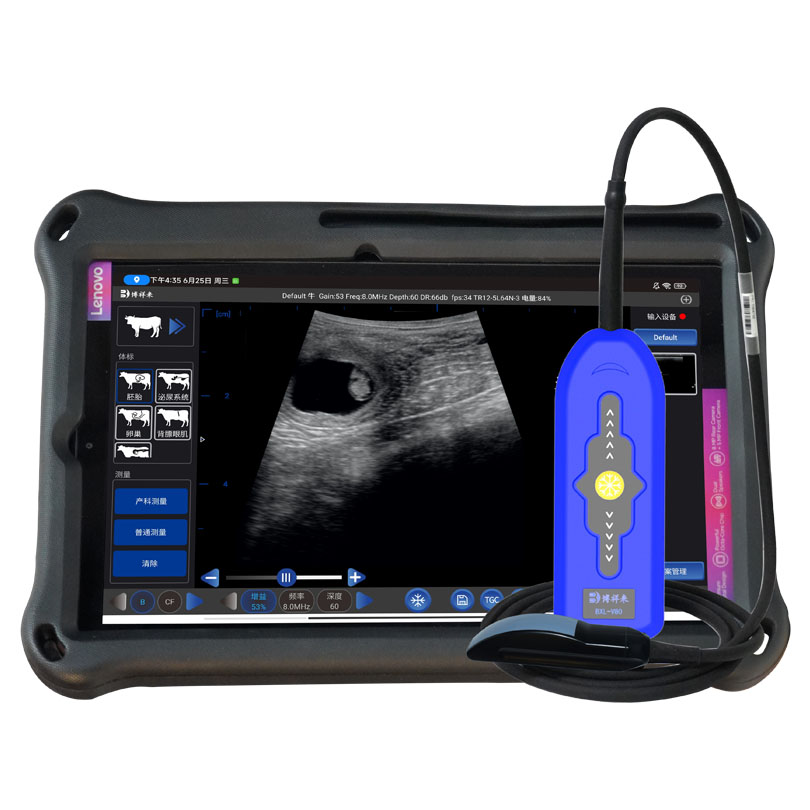
Transrectal ultrasound cattle is a diagnostic imaging technique in which a specialized linear rectal probe is inserted into the rectum to obtain real-time ultrasound images of the uterus, ovaries, cervix, and developing fetus.
Unlike manual rectal palpation, ultrasound enables veterinarians to directly observe reproductive structures without relying solely on tactile assessment.
The examination is widely used for:
Early pregnancy diagnosis
Pregnancy confirmation
Ovarian follicle evaluation
Corpus luteum assessment
Embryo transfer programs
Artificial insemination (AI) management
Detection of reproductive diseases
Monitoring fetal development
The procedure is safe, non-invasive, and suitable for routine herd reproductive management.
Why Transrectal Ultrasound Is Better Than Rectal Palpation
Although rectal palpation remains a common diagnostic method, ultrasound offers significantly more clinical information.
Earlier Pregnancy Detection
Transrectal ultrasound can detect pregnancy as early as 26–30 days after breeding, allowing producers to identify non-pregnant cows sooner and reduce unnecessary waiting periods.
Earlier diagnosis helps improve breeding schedules and increases reproductive efficiency.
Real-Time Visualization
Ultrasound provides clear images of reproductive organs, allowing veterinarians to observe:
Embryonic vesicles
Fetal heartbeat
Fetal movement
Placental development
Uterine fluid
Ovarian follicles
Corpus luteum
This real-time imaging greatly improves diagnostic confidence.
Higher Diagnostic Accuracy
Modern veterinary ultrasound machines produce high-resolution images that allow veterinarians to distinguish between:
Normal pregnancy
Embryonic loss
Twin pregnancies
Ovarian cysts
Uterine infections
Reproductive abnormalities
The improved accuracy supports better clinical decision-making.
Applications of Transrectal Ultrasound in Cattle
Veterinary ultrasound has become an essential tool throughout the reproductive cycle.
Early Pregnancy Diagnosis
Early identification of pregnancy allows producers to quickly rebreed open cows and improve herd fertility.
Ultrasound also confirms fetal viability through visualization of the fetal heartbeat.
Ovarian Monitoring
Monitoring ovarian structures is essential during synchronization and breeding programs.
Ultrasound can identify:
Growing follicles
Ovulation status
Corpus luteum development
Follicular cysts
Luteal cysts
Accurate ovarian evaluation improves artificial insemination timing.
Embryo Transfer Programs
Embryo transfer requires precise reproductive assessment.
Ultrasound assists with:
Donor selection
Recipient synchronization
Pregnancy confirmation
Embryo survival monitoring
This technology has become indispensable in advanced cattle breeding programs.
Reproductive Disease Diagnosis
Transrectal ultrasound helps detect numerous reproductive disorders, including:
Endometritis
Pyometra
Ovarian cysts
Uterine infections
Delayed uterine involution
Early diagnosis reduces economic losses and improves treatment outcomes.
Benefits of Portable Veterinary Ultrasound Systems
Portable veterinary ultrasound equipment has transformed field diagnostics.
Major advantages include:
Lightweight Design
Portable scanners are easy to transport between farms and require minimal setup.
High Image Quality
Digital imaging provides excellent visualization of reproductive organs and early pregnancies.
Long Battery Life
Extended battery performance supports full-day farm visits.
Wireless Connectivity
Many modern systems support Wi-Fi or Bluetooth image transfer, enabling rapid report generation and remote consultation.