Ultrasound Bovine Solutions: Advanced Veterinary Imaging Equipment for Cattle Reproduction

Ultrasound Bovine Solutions: Advanced Veterinary Imaging Equipment for Cattle Reproduction
Improve Cattle Reproductive Management with Professional Bovine Ultrasound
Modern cattle farming requires efficient reproductive management, reliable diagnostic tools, and practical equipment that can work in demanding farm environments. Ultrasound bovine technology has become an important tool for veterinarians, cattle breeders, dairy farms, and beef cattle operations seeking to improve reproductive monitoring and make informed herd-management decisions.
A professional bovine ultrasound machine enables real-time examination of reproductive structures and supports pregnancy diagnosis, ovarian monitoring, and other veterinary applications when used with suitable probes and examination protocols.
Zhengzhou Boxianglai Electronic Sci-Tech Co., Ltd., operating under the Boxerly brand, specializes in the development and manufacture of veterinary ultrasound imaging equipment for large animals. With in-house production capabilities, product development experience, and a range of portable ultrasound and Doppler systems, Boxerly provides equipment options for international veterinary professionals, livestock farms, and veterinary equipment distributors.
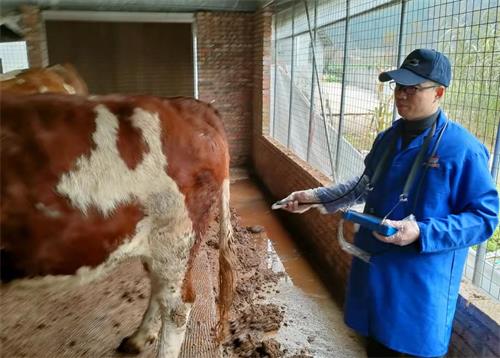
Whether you are searching for a bovine ultrasound scanner for routine pregnancy diagnosis or an advanced veterinary ultrasound system for reproductive assessment, selecting the right equipment is an important step toward an efficient livestock management workflow.
What Is Bovine Ultrasound?
Bovine ultrasound refers to the use of ultrasound imaging to examine cattle. By transmitting high-frequency sound waves and processing the returning echoes, an ultrasound system generates real-time images of internal anatomical structures.
In cattle reproduction, ultrasound imaging can help trained veterinary professionals examine the uterus, ovaries, follicles, corpus luteum, and pregnancy-related structures.
Compared with relying only on external signs, ultrasound provides direct imaging information that can support reproductive assessment. The interpretation of these images requires appropriate training, a suitable scanning method, and consideration of the animal’s reproductive history.
Common applications of bovine ultrasound include:
Cattle pregnancy diagnosis
Reproductive tract examination
Ovarian follicle monitoring
Corpus luteum assessment
Fetal development monitoring
Reproductive management in dairy and beef cattle
Doppler-based blood-flow assessment on compatible systems
The available applications depend on the equipment model, transducer, software functions, and examination protocol.
Why Is a Bovine Ultrasound Machine Important for Cattle Farms?
1. Supporting Cattle Pregnancy Diagnosis
Pregnancy diagnosis is one of the most common applications of a cattle ultrasound machine.
Ultrasound examination can help veterinarians identify pregnancy-related structures and assess the reproductive status of cattle at an appropriate stage. This information can support breeding schedules, follow-up examinations, and herd reproductive records.
The timing of pregnancy diagnosis depends on the examination technique, equipment, and operator experience. Early pregnancy examinations should follow an appropriate veterinary protocol.
For dairy farms and beef cattle operations, an organized pregnancy-scanning program can help managers identify animals requiring further attention and plan reproductive activities more efficiently.
2. Monitoring Ovarian Follicles
Ovarian follicle monitoring is useful in reproductive programs involving estrus synchronization, artificial insemination, and other breeding management procedures.
With a suitable probe and scanning technique, bovine ultrasound can help trained professionals visualize ovarian structures and monitor follicular development.
Regular examinations can provide information for reproductive assessment, although the interpretation of follicle size and development should be based on veterinary expertise and the specific breeding protocol.
3. Assessing the Corpus Luteum
The corpus luteum is an important ovarian structure involved in the reproductive cycle of cattle.
B-mode ultrasound can help visualize ovarian structures, while Doppler ultrasound can provide additional information about blood-flow characteristics.
In appropriately designed reproductive protocols, corpus luteum blood-flow assessment may contribute to early pregnancy evaluation. Results depend on the Doppler system, examination timing, scanning technique, and clinical interpretation.
For breeding centers and reproductive specialists, this makes advanced bovine Doppler ultrasound worth considering when routine imaging alone does not meet their needs.